News
Behind the Scenes at the British Bouldering Championships, 2025.
It’s 2019; you’re at Harrowall coaching Flynn Ingram at the Junior British Bouldering Championships, there’s 1hour left of qualification and a queue is building in front of a couple of […]
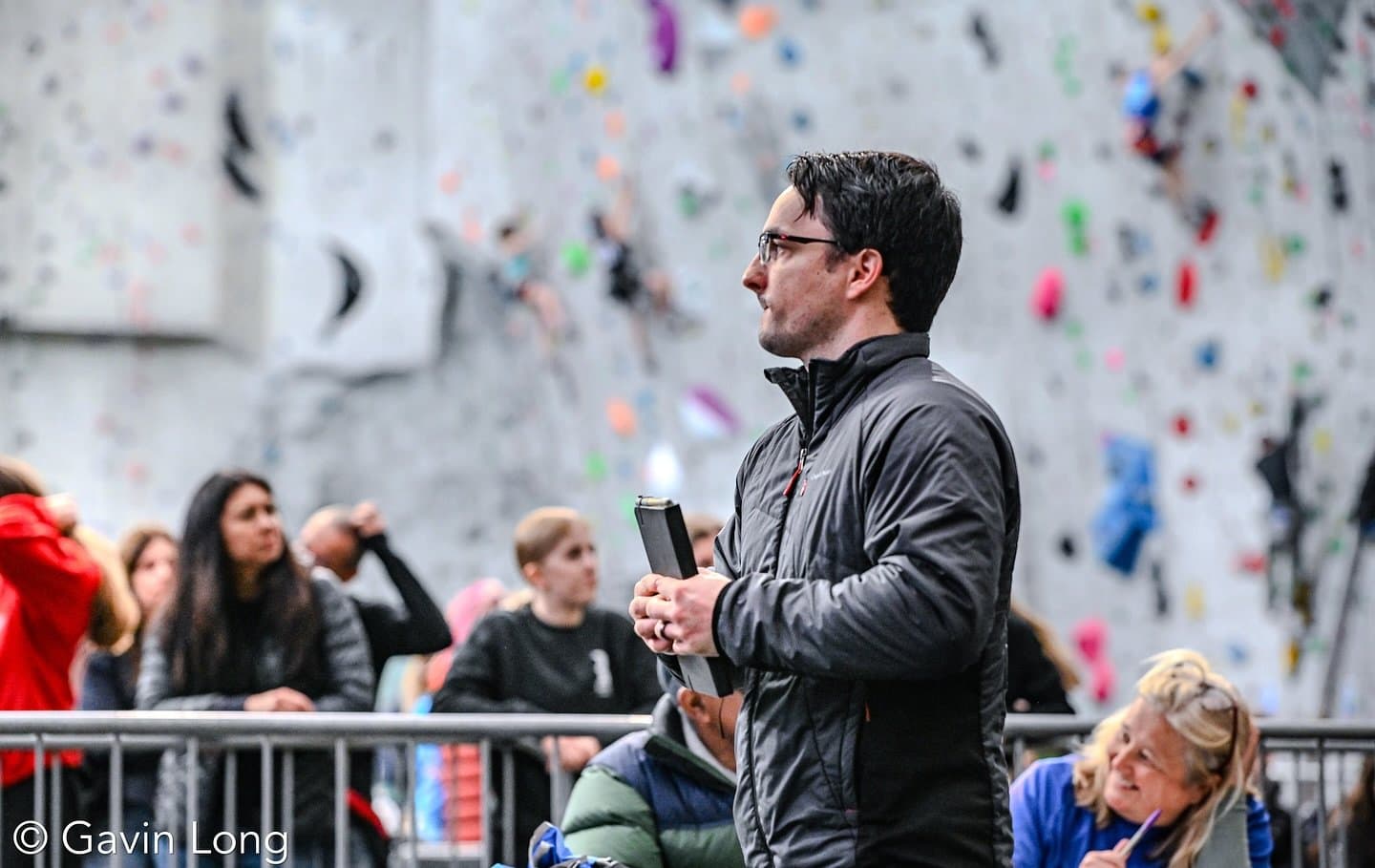
It’s 2019; you’re at Harrowall coaching Flynn Ingram at the Junior British Bouldering Championships, there’s 1hour left of qualification and a queue is building in front of a couple of boulders; currently no one is able to climb them so you decide to let the Event Organiser know. Zoe is talking with Alex Fry (Chief Setter of the Comp) who puts a clipboard in your hand with a “there you go then” comment.
Little do you know, this brief exchange would start a new chapter in your life. Somehow, a couple of weeks later, you’re Judging at your first British Bouldering Championships; 2022 sees you at an IFSC World Cup as National Judge (the same weekend Queen Elizabeth died in Scotland), and the 2024 seasons solidifies your role as Senior Competition Official with GB Climbing.
It’s been a wild ride, but that’s my story… and I’m psyched to be part of this Team!
“I saw you on TV at the weekend…”
This is something I hear a lot around Shack following a National Championships, and to be honest, I’m never quite sure how to respond. I’ve written this blog post to give a little insight into what goes on behind the scenes, and what it takes to deliver a British Boulder or Lead Championships.
So, for those of you who don’t know me, I’m Ollie. I am Centre Manager and Head Route Setter at Shack, and have been working here since 2017.
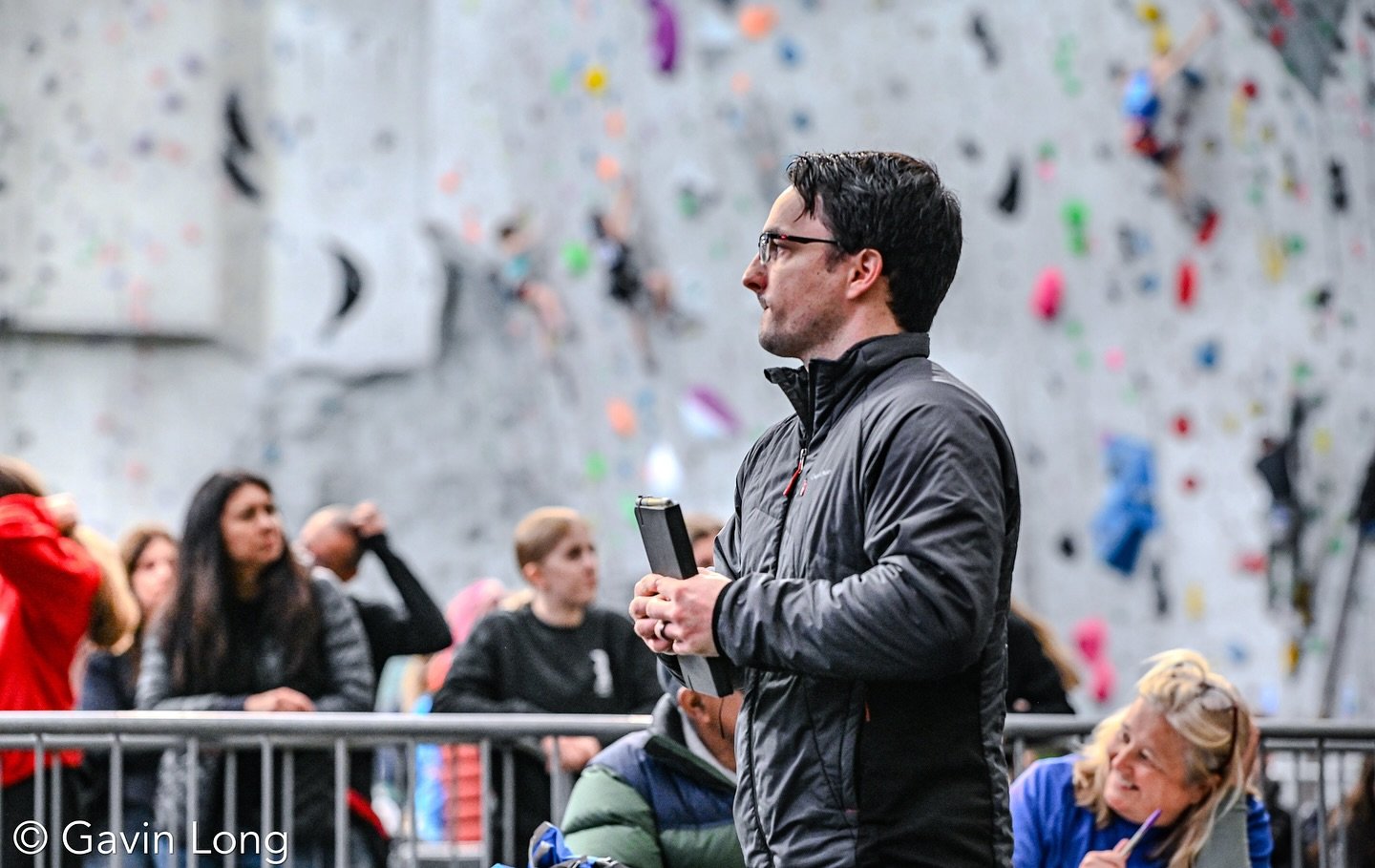
©Gavin Long. Me at the British Lead Climbing & ParaClimbing Championships (BLCC’s) 2024 – ‘Edinburgh International Climbing Arena’ – Head Judge.
What is a Competition Official?
Before we go any further I think it’s important to give a little context into what we do whilst in the venue. There are four key roles:
Event Organiser – This role is always taken by Zoe, who works for GB Climbing as ‘Competition Programme Manager’. This is a colossal role, and she is responsible for everything required to deliver the competition (e.g. host venue procurement, schedules of the event, organising the live stream, communicating with the setting and Officials team, sorting accommodation. The list is endless…). Once we’re in the venue, Zoe makes sure that everything she has planned is possible, and we have the resources needed to deliver the event.
Jury President – This role has overall authority within the Competition Area. They make sure that the athletes are safe, and lead with processing technical incidents that arise during the Competition. The JP is responsible for the application of the rules on the field of play, and more widely for the event as a whole. They also form the Appeals Panel alongside the Head Judge if an athlete’s score is questioned.
Head Judge – This role is responsible for all tasks regarding the application of rules (within the competition area) and scoring during the competition. This will involve briefing the judging team and being on hand should anyone need input during the competition.
*These three roles form the Senior Officials Team; we’re generally really busy before the Competition starts, but if we’ve done a good job preparing the Competition, once the athletes begin climbing we should be in the shadows. Depending on disciplines we take on specific tasks, such as creating/ signing-off ‘Topo’s’ used to score lead routes; this is often done in collaboration with the Setting Team.
Judge – This role is the person you would see on the live stream watching each climber, scoring their climb. Deciding if they meet the thresholds for scores to be awarded. This role can be relentless, as you have to focus for hours at a time.
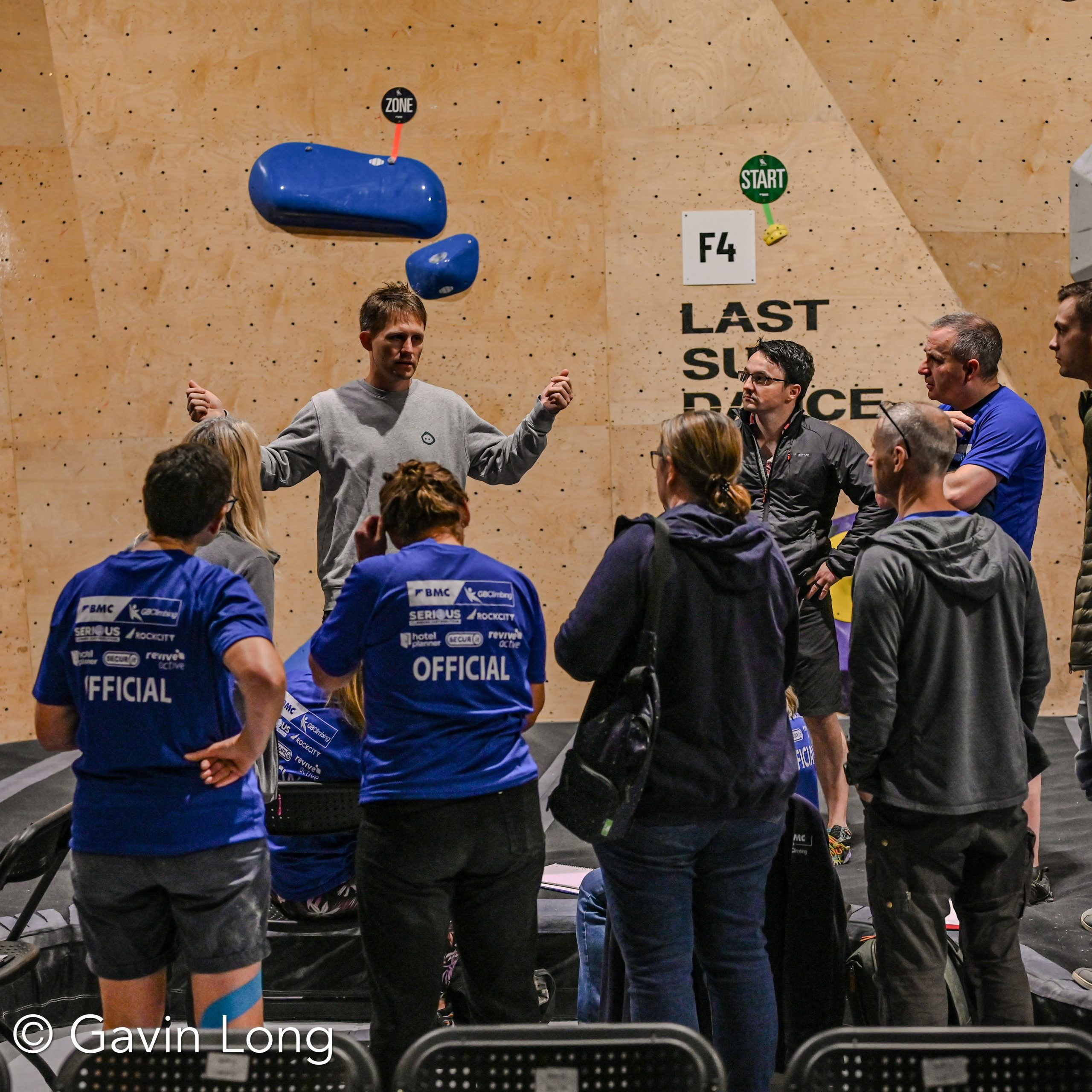
©Gavin Long. Freddie Naish delivering the Judges brief ahead of the Qualification Round at the 2024 British Bouldering Championships (BBC’s), ‘Last Sundance’, Leeds.
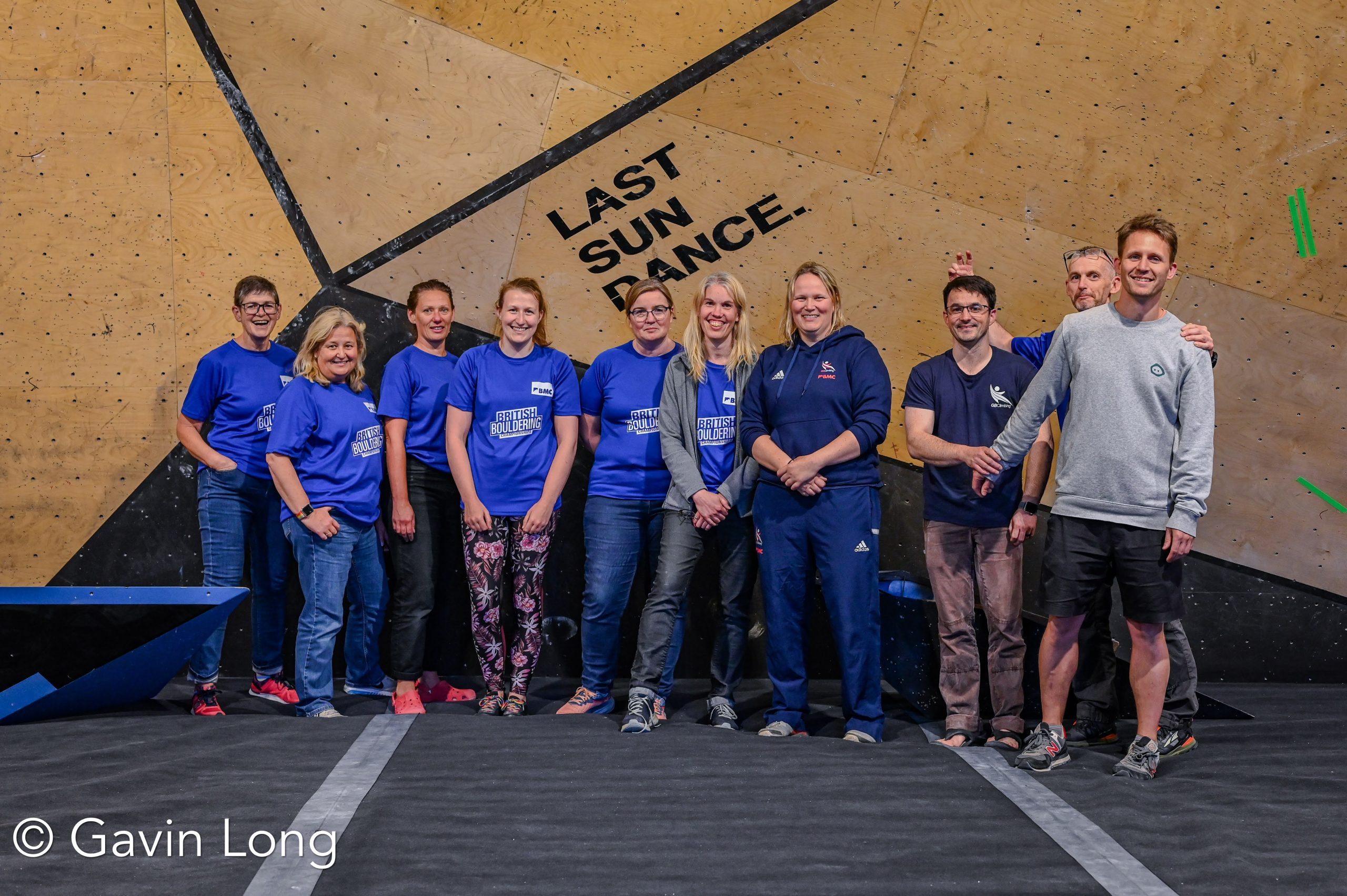
©Gavin Long. Cheggs, Tanya, Kerry, Catrin, Penny, Sam, Zoe, Me, Paul & Freddie; the Officials Team of the 2024 British Bouldering Championships, ‘Last Sundance’, Leeds.
2025 saw quite a significant change to the programe; usually the BBC’s and BLCC’s happen in August and September respectively. A closed door selection weekend for each discipline occurs early in the year, the results of this decide who is going to be selected for International Competitions that year. For a series of reasons these two events were combined, so that selection and the National Championships were the same event held early in the year. This had one major impact, the whole field of athletes had to attend in order to qualify for the International season; this definitely made the events feel more special. A second major impact was that the events included U17’s, whereas usually only the Senior field attended.
Both BBC’s and BLCC’s were hosted by ‘Big Depot, Manchester’, and let me tell you, they didn’t lie, the centre is absolutely massive!
We were aware from towards the end of 2024 that the IFSC were going to be changing their scoring system for Boulder World Cups away from ‘Tops & Zones’ to a system similar to the Olympics. The ‘zone’ to be replaced by a 10point score, and ‘Top’ to become worth 25points, with 0.1 being lost each attempt. These were officially released a couple of weeks before the BBC’s, and the GB Climbing ‘Performance Team’ were obviously keen for us to adopt this format. I wasn’t part of the meetings surrounding this, but we decided to keep the ‘traditional’ ‘Tops & Zones’ scoring format.
So what happens before the cameras are turned on?
I’m not going to comment on the mountain of work Zoe did before, let’s just agree that’s not a role I’m keen for…
The setters arrive on Tuesday/ Wednesday and begin with setting their finals round. They mark-up the wall, collect the holds together and hide them somewhere in the centre. Thursday they repeat this process with the Semi-Finals, and Friday again for the Qualification round, although these stay on the wall overnight. Usually they would only have one category to deal with, but this time the workload was doubled as they had to set Seniors and U17’s.
Thursday:
Thursday evening we host a ‘Technical Meeting’. This is an opportunity for us to brief the athletes and coaches about what to expect during the event; introduce the setting and officials team and give any the opportunity to ask questions they may have.
Friday:
Friday morning I dropped my eldest at school, then jumped in my car and made the journey North to the venue. I love going to new venues, as it always poses new challenges and forces us to adapt what we do. This venue gave us some unique challenges. First thing when we arrive is to go and say hello to everyone; this event was great because we had worked with Centre Manager, Dan at the Junior British Boulders in 2024, so we already had a relationship with him. Say hello to the Setting Team, and other Officials that have arrived. Next thing is to get a lie of the land.
For these events, Freddie Naish was Jury President for the event as a whole, I was Head Judge for Senior’s and Catrin Rose was Head Judge for U17’s. Once we’re all on-site it’s time to have a meeting about logistics. We need to consider things like, where will isolation be? Which way will the boulders run (right to left, left to right, or scrambled), where will the ‘Call Zone’ be, and the ‘Transition Area’. These are where the athletes start their climbs from, and where they sit for a rotation after their last climb before they can be released into the crowd.
Because we had ‘two rounds’ of climbing (Senior & U17), we were allocated an area of the centre that allowed climbing on both sides of the ‘valley’. You can see in the photo below that during Semi-Finals and Finals, the crowd were sat underneath climbs for the opposite age category. The programe ran U17 Semi-Finals before Senior started; and in that change over period the crowd had to pick up their chair and move it across to the other side of the Competition Area. Unique for sure…
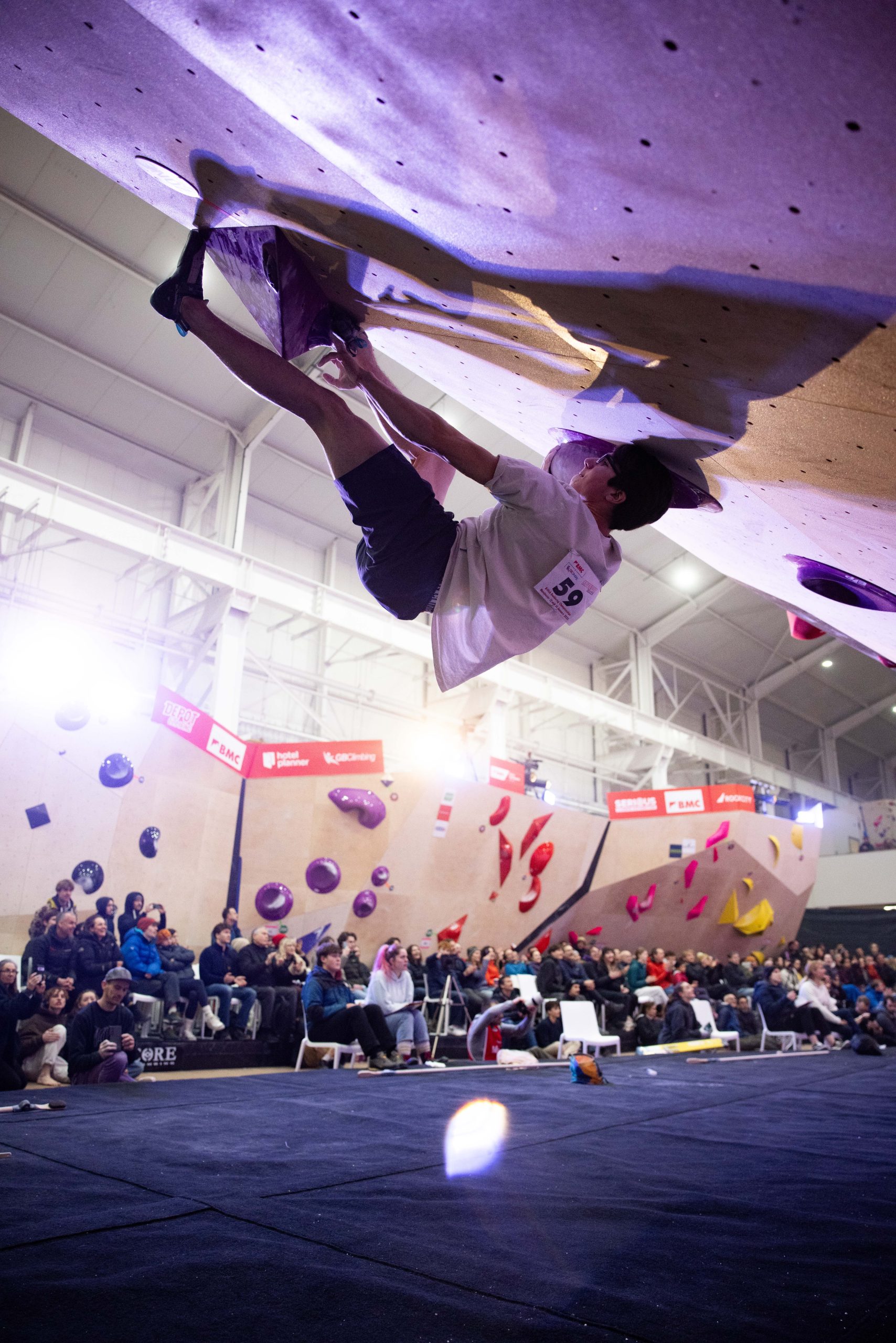
©Sam Pratt. Jack Macdougall climbing during the Semi-Finals.
Then really our job is to help get the Competition Area ready for the Competition to run, and at this stage it’s really a question of, what can we do to help the Setting Team? Anyone who has seen us working for a Mega Series at Shack will understand that route setters are mucky pups, myself and Freddie tidied all the surplus holds away, this took nearly 3hrs for the BBC’s. Then we taped, and secured all the blocs that had been ‘signed-off’. Next-up is sorting demonstration videos of the boulders that need to be released to the athletes. Then we’re not far off being able to go home. This year at the BBC’s I arrived at the venue at around 13:30 and left for our AirBnB at around 22:30. Thankfully we’re a great team and those who weren’t needed headed home earlier to cook dinner for everyone. We’re really lucky that Cheggs is a Chef for the GB Sailing Team, so the food is always pretty good!
Saturday:
Because my body is stupid, I’ll wake-up at about 05:00 on a Competition morning. It’s really easy during an event not to spend any time outside, so where possible I’ll have a shower, then breakfast outside enjoying the quiet. Then, off to the venue for about 07:15.
Athletes need 90minutes minimum for warm-ups, so if the Competition starts at 10:00, we have to be ready to open registration at 08:30.
Around 45minutes before the first competitor starts we will deliver our Judge’s Brief. We have a well established team of National Judges, so these briefs aren’t usually a time for us to re-cap the rule book, they know what they’re doing. The briefs often cover logistical challenges we are likely to encounter, touch base with how everyone’s feeling, and brief for specific things of interest. This year, we decided to be focused on people starting and finishing appropriately. We see at World Cup’s people giving ‘quick taps’ on start positions, and sometimes dismounting quickly. If we are really hot on this at National level, it hopefully allows those attending International Competitions to get into good Competition habits.
All that is left is to allocate the Judges to their blocs and talk through any questions they may have. Through a combination of experience, and watching the Setting Team testing the blocs we have an idea of if any blocs may have marginal calls to make, so we tend to put those more confident on those blocs or have a longer conversation with that specific Judge before the Competition starts. As Head Judge I will also (if not called away elsewhere) spend the first couple of athletes with these blocs to help settle in the Judge. This is helped as higher ranked athletes come out first, which often makes decision making easier.
Once the athletes begin climbing that is when nerves settle. If we’ve done our job well, myself, Freddie and Cat should be quite out of the way during climbing. It became quickly evident that the biggest problem we were going to encounter at the BBC’s was blood.
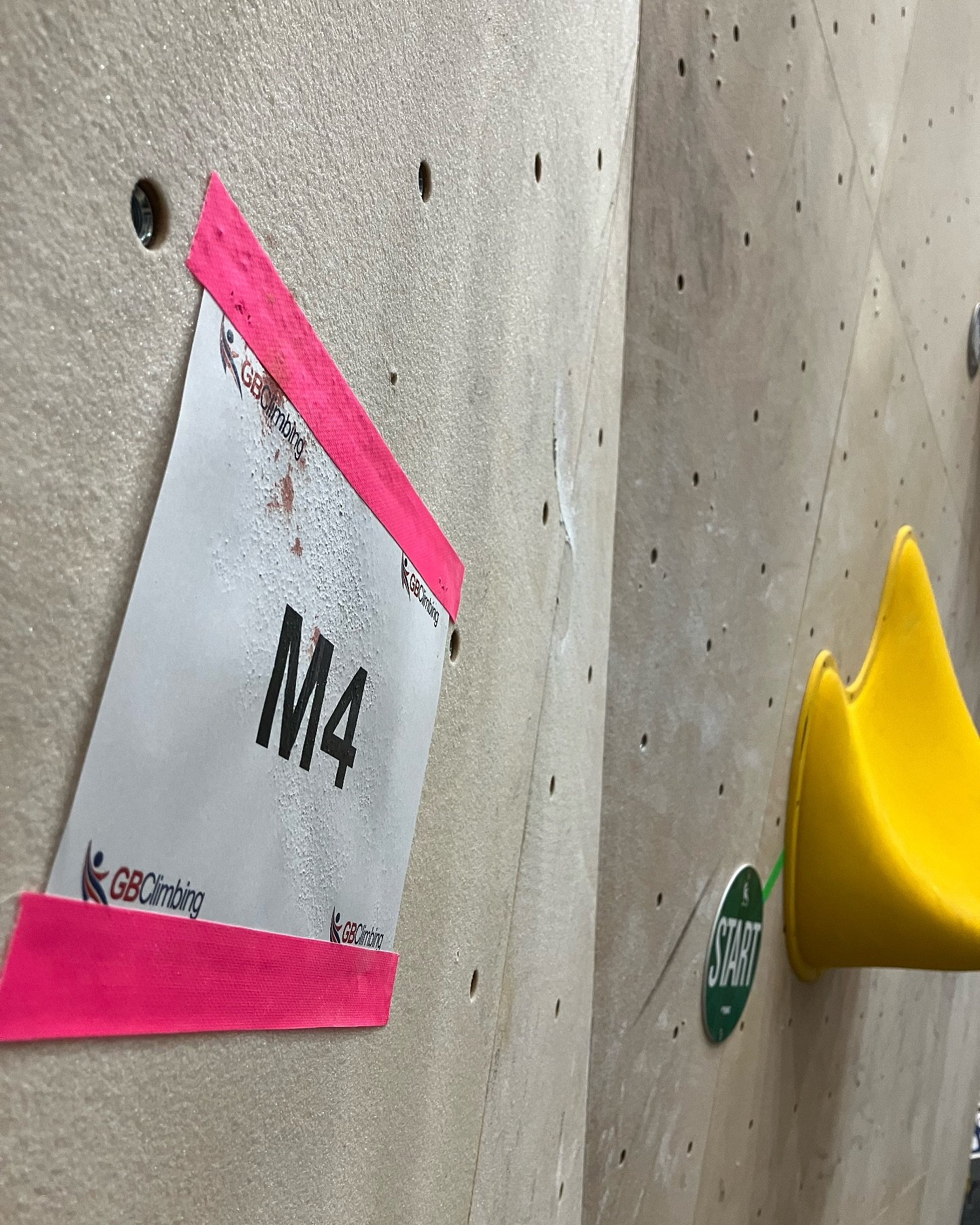
Blood on the Route Label of M4 following Qualification of the BBC’s 2025.
Obviously it isn’t safe for people to be bleeding whilst climbing; the holds get ‘wet’, making them harder to hold. Not to mention the health hazards associated with blood. The problem was worse than normal due to the wall being very new, the centre had only been open for around 1month; but also the texture on the wall panels is very aggressive. Blood protocol falls into the realm of HJ & JP, so off to work we go… Athletes have to stop bleeding before they are allowed to continue climbing, they often use a combination of tape and super glue. The test that we use is to dab the wound with a piece of tissue, if blood is transferred they have to try again. During this process the route setters grab some spray and a brush to clean the holds, volumes or wall. The athlete’s time does not stop, and if their whole rotation is spent dealing with a blood incident, then that is unfortunately the end of their rotation.
I mentioned that the days are long; there were 153 Senior athletes competing this year, climbing started at 10:00 with Erin & Toby, and finished with Archie at 19:15. An athlete started every 5minutes between those times; thankfully the team are great and once a smaller category finished they helped sub-out for others who had been going longer.
That’s the athletes done, along with the Judging Team; but the Setters, myself and Freddie aren’t. We need to prepare the area for Semi-Finals the following morning. All the blocs are stripped, myself and Freddie tidy those away (into a big pile out back) whilst the setters rebuild for Semi’s. We finish work at around 23:00 and head to the AirBnB for bed.
Sunday:
Sunday is really much the same. The main difference is that we need to set-up an isolation area for the athletes to enter away from the public. We need to isolate the athletes because Semi-Finals and Finals are both ‘on-sight’. When athletes enter isolation they have to surrender any electronic device that is capable of receiving information; that’s why you see athletes with wired headphones connected to mp3 players.
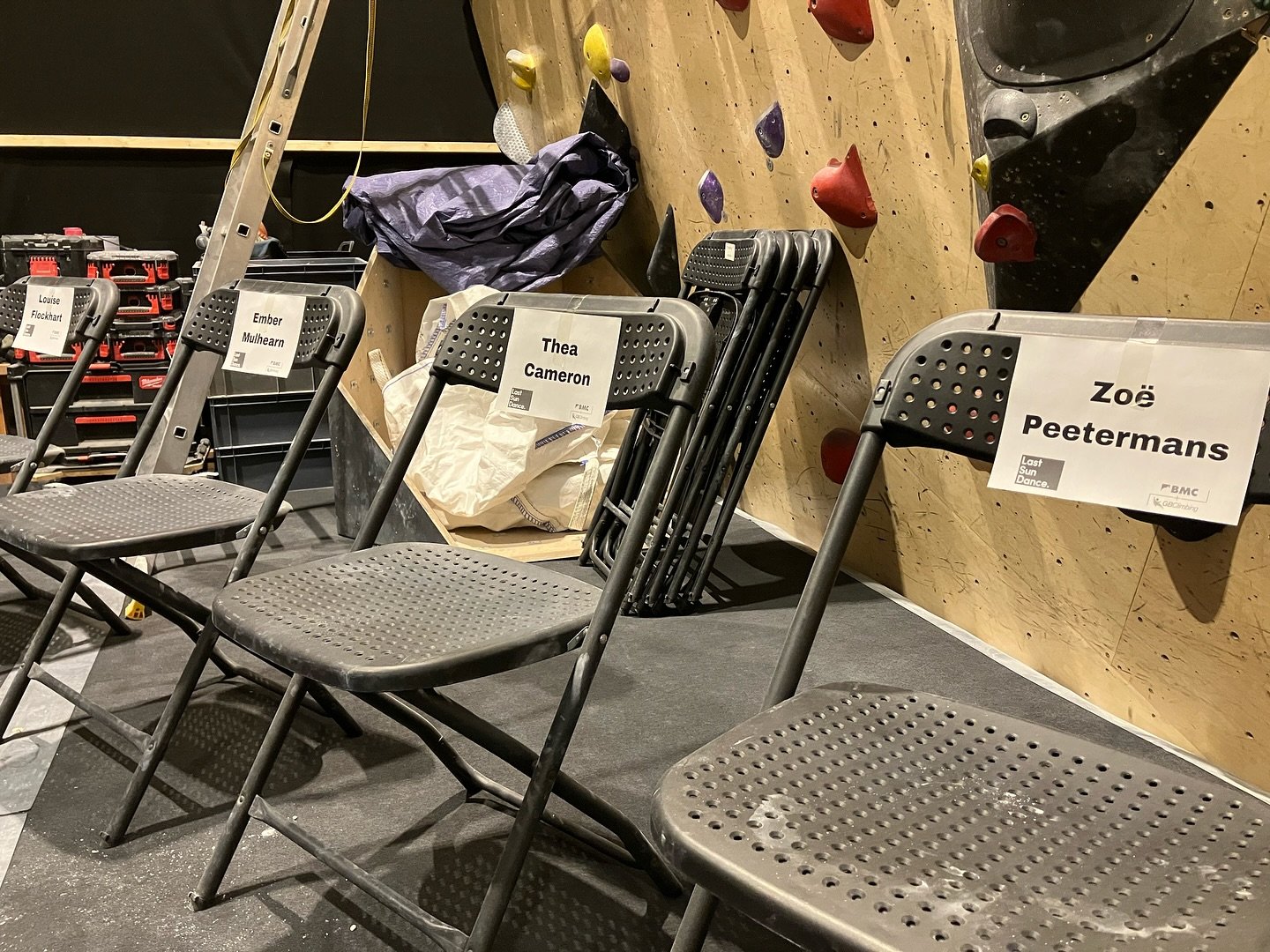
Finals Isolation at the 2024 British Bouldering Championships, ‘Last Sundance’, Leeds.
We touch base with the Judging team again, to talk about the logistics of the day, then it’s time for the athletes to come and do their thing…
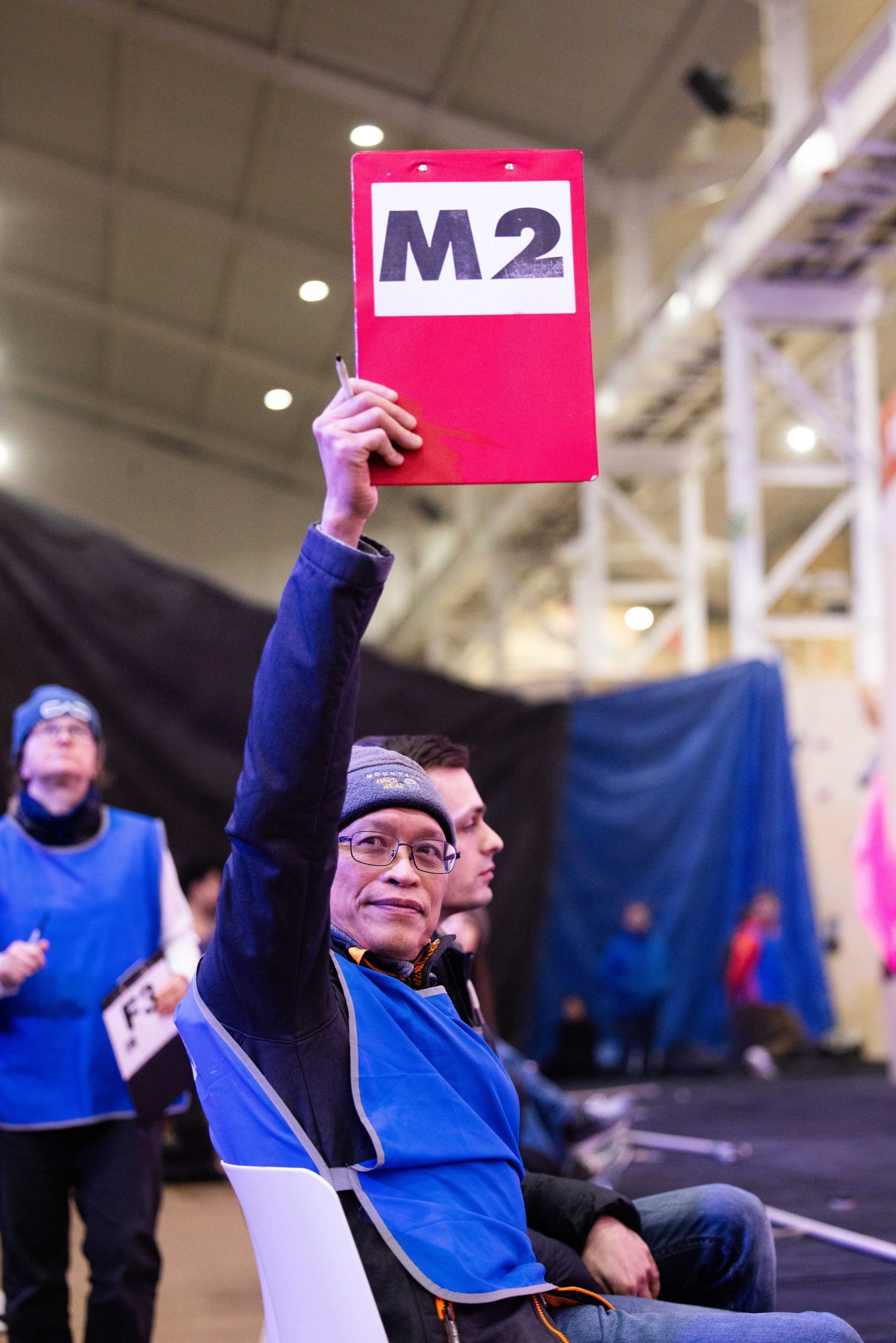
©Sam Pratt. Sammy Yick waiting for his next athlete during Semi-Finals.
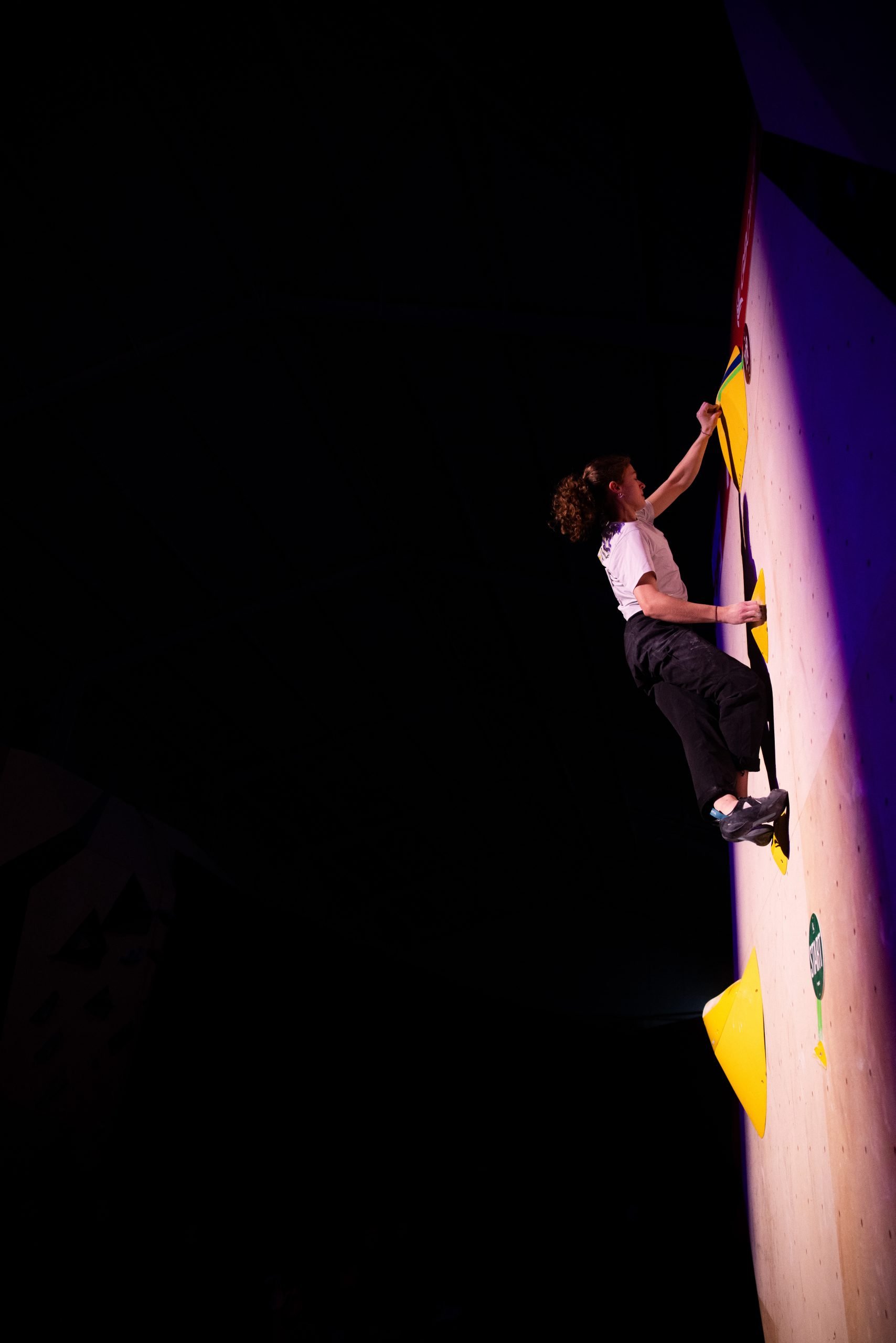
©Sam Pratt. Holly Toothill going for the match Top on F1 during Finals.
This moment was one of the only ‘controversial’ moments from the Senior event. In the photo you can see Holly controlling the ‘Top’ hold with one hand. She matched the hold with seconds to spare, the Judge’s awarded the top and she left the ‘Field of Play’ for her space in Isolation. As Head Judge I have the ability to overrule a decision made by a member of the Judging Team; however I was dealing with an incident at the other end of the wall so did not see the events unfold. Would I have stepped in if I was closer? I don’t know…
Another athletes’ Dad found me and requested to put in an appeal. This process brought myself and Freddie together. The person completes a form detailing what they would like to appeal against and which rule; in this case it was that Holly did not demonstrate control with both hands on the ‘Top’ hold (Rule: 8.17.B.1. (Yes I’m that sad)). Myself and Freddie have access to Official video that we are able to review in order to make our decision. On review of the footage it was decided that Holly did not ‘control’ the ‘Top’ hold with both hands, as her hips were in constant motion before she dismounted. The result of this is that Holly had her ‘Top’ taken off her scorecard.
When something comes to review, the panel are fortunate that we are able to look at the footage without the emotion of the crowd, or real time decision making. When a marginal call is made like this one, all we can ask the Judging team to do is make a decision one way or the other; and be consistent with their decision making throughout the round, easier said than done sometimes. We don’t like deducting scores from athletes, we always much prefer to upgrade someone’s score; however we understand that it is a necessary aspect of our role. Useless fact time: At a GB Climbing organised event, if you make an appeal, and it is rejected you have to pay a £35 fee.
Once the Comp has finished we head back to the house for a well earned dinner and glass of wine…
A couple of weeks after the competition we get together on Zoom for a debrief, where we reflect on what went well and what we could improve for next time. This year we were joined by Sammy (pictured above) for the first time. Sammy is an IFSC L3 Judge who has moved to the UK from Hong Kong. We were also joined by Sandro Pfister (Competition Manager) from the Swiss Federation. Sandro was the brain behind delivering the 2023 World Championships in Bern. Their insight into the weekend was invaluable, and they were both impressed with the quality of the competition we were able to deliver. Some great suggestions were made on how we can tweak our workflows/ processes to take our next series of events to the next level, again.
So there you are… That’s a little behind the scenes of a National Climbing Competition. I’ve a few exciting things lined up for the rest of 2025. But maybe more about those another time…